

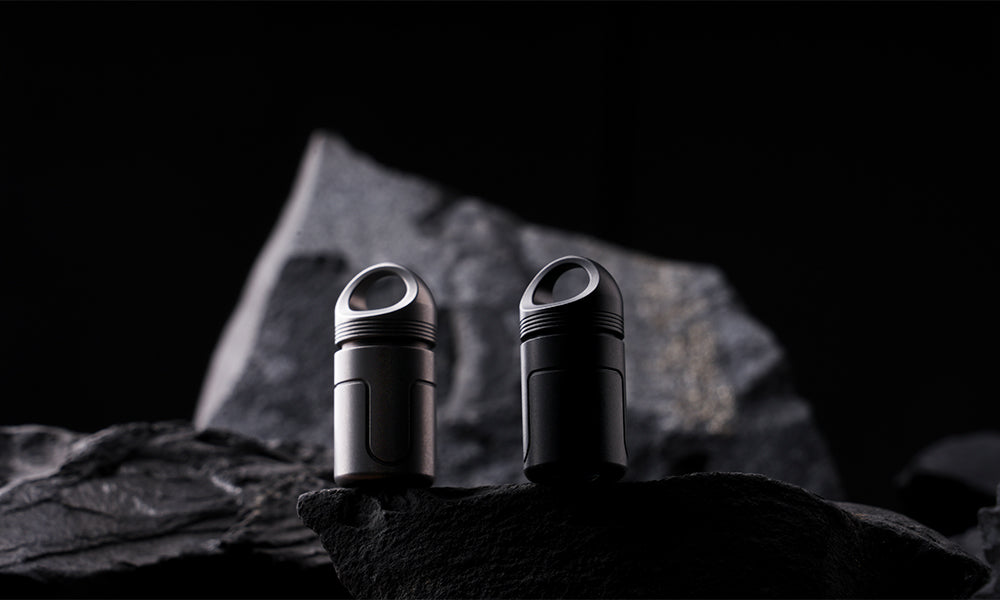
Titanium looks simple: a silver-gray metal that stays light, strong, and quiet in daily use. Behind that surface is a material used in jet engines, surgical implants, ocean hardware, and everyday carry tools. If you are comparing titanium products — or deciding whether Grade 5 or Grade 1 is the right choice — this guide explains the metal in practical terms.
This is not a chemistry textbook. It is a working overview of what titanium is, how common grades differ, why the price is higher than steel or aluminum, how color is created through anodizing, and how Belloc selects alloys for EDC tools versus food-contact items.
What Is Titanium?
Titanium (chemical symbol Ti, atomic number 22) is a transition metal. In its finished form it is typically a lustrous silver-gray. The name comes from the Titans of Greek mythology. The element was identified in 1791 in Cornwall, England, by William Gregor, and later named by Martin Heinrich Klaproth.
A few facts matter more than the mythology:
-
Titanium is abundant in the Earth’s crust — among the most common metallic elements — but it is expensive to extract and refine.
-
Commercially pure titanium has a density of about 4.51 g/cm³, roughly 40% lighter than typical steel (~7.8 g/cm³).
-
Grade 5 (Ti-6Al-4V) is slightly lighter still, around 4.43–4.47 g/cm³.
-
Pure titanium melts near 1,668 °C (about 3,034 °F). Grade 5 melts over a range, roughly 1,604–1,660 °C.
-
The oxide film that forms on contact with air is the reason titanium resists seawater, sweat, and many chemicals so well.
Alloys keep titanium’s core advantages and add strength, heat stability, or formability. That is why most high-load consumer products use an alloy, while food-contact surfaces often stay with commercially pure grades.
Titanium vs Stainless Steel vs Aluminum
Search demand for “titanium vs steel” and “titanium vs aluminum” is high because buyers need a decision, not a definition. Use this comparison as a starting point.
|
Property |
Titanium (CP / Grade 5) |
Stainless steel (typical 304/316) |
Aluminum (typical 6061) |
|---|---|---|---|
|
Density |
~4.4–4.5 g/cm³ |
~7.9 g/cm³ |
~2.7 g/cm³ |
|
Strength-to-weight |
Excellent (Grade 5 rivals many steels at lower weight) |
High strength, heavier |
Light, lower strength unless thick |
|
Corrosion resistance |
Outstanding in salt, sweat, many chemicals |
Good (316 better than 304) |
Good until coating or oxide is damaged |
|
Magnetic behavior |
Essentially nonmagnetic |
Some grades are magnetic |
Nonmagnetic |
|
Skin comfort |
Generally hypoallergenic |
Nickel in some alloys can irritate |
Usually fine; less “premium” feel |
|
Raw material cost |
Highest of the three |
Lowest |
Mid |
|
Typical consumer use |
EDC, jewelry, implants, premium cookware |
Knives, watches, kitchen tools |
Frames, cases, cookware cores |
Practical takeaway: Aluminum wins on lowest weight and lowest cost. Stainless steel wins on hardness, edge-holding (as a blade steel), and price. Titanium wins when you need steel-like strength without steel’s weight, plus corrosion resistance and skin compatibility that last for years.
A titanium part of comparable strength can weigh on the order of 40–45% less than a steel part. That is why aerospace, medical, and premium EDC brands accept the higher material cost.
What Color Is Titanium?
Unfinished titanium is silvery gray to silvery white. That natural color is stable. It does not tarnish the way silver does, and it does not rust the way carbon steel does.
Color beyond silver usually comes from anodizing, not from paint or dye. Anodizing grows a transparent titanium-oxide film. Light reflecting from the metal and from the top of that film interferes with itself. Different film thicknesses produce different colors: bronze, gold, rose, purple, blue, teal, and green.
A few limits are physical, not stylistic:
-
True red is not available through standard anodizing.
-
True black is not an anodized interference color; black finishes usually come from PVD, DLC, or similar coatings.
-
The same voltage can shift a few volts depending on alloy, surface polish, bath chemistry, and temperature.
Natural titanium still looks premium. Anodized titanium adds identification, brand color, and a harder oxide surface without hiding the metal underneath.
How Much Does Titanium Cost?
Titanium costs more than stainless steel or aluminum at every stage: sponge production, melting, forging, machining, and finishing. Published spot prices move with energy costs and aerospace demand, so treat any per-kilogram figure as a snapshot, not a quote.
As a rough order of magnitude for bulk metal, stainless steel may sit near the low single-digit dollars per kilogram, aluminum a little higher, and titanium mill products many times that — often tens of dollars per kilogram for raw stock, and much more after CNC machining and finishing. Finished consumer goods cost more still because titanium is slower to cut and harder on tools.
The useful question is not “Why is titanium expensive?” It is “Does the extra cost pay back?”
Titanium pays back when:
-
The part is carried or worn every day (weight and corrosion matter).
-
The part sees sweat, salt air, or dishwashing.
-
Replacing a cheaper part would cost more over five to ten years.
-
Skin contact must stay comfortable (nickel-sensitive users).
A titanium buckle, razor, or cup can outlast several generations of plated or coated alternatives. The first purchase is higher. The cost per year of use is often lower.
Common Titanium Grades Explained
ASTM titanium grades fall into two families: commercially pure (CP) grades and alloys. CP grades (1–4, plus palladium-bearing 7 and 11) differ mainly by oxygen and iron content. More oxygen generally means higher strength and lower ductility. Alloys add aluminum, vanadium, tin, molybdenum, or nickel for strength or heat performance.
There is no single “best” grade. There is only the grade that matches the job.
Grade 1 — softest commercially pure titanium
Grade 1 is the most formable CP grade: about 99% titanium, with tightly limited iron and oxygen. It bends, draws, and welds cleanly. Strength is the lowest of the common CP grades, which is an advantage for cookware liners, cups, and other food-contact parts that must be shaped and must stay chemically quiet.
Typical uses: piping, heat-exchanger tubing, cladding, and food-safe surfaces.
Grade 2 — the workhorse CP grade
Grade 2 is the most widely used commercially pure grade. Slightly more oxygen than Grade 1 gives it more strength while keeping good weldability. It is a default choice for chemical plant linings, power-generation equipment, and general corrosion service.
Grade 3 — stronger CP, less common
Grade 3 sits between Grade 2 and Grade 4. It is stronger, a little less ductile, and used less often. Typical homes are condenser tubing, cryogenic vessels, and chemical equipment that needs more strength than Grade 2 without moving to a full alloy.
Grade 4 — strongest commercially pure titanium
Grade 4 is the strongest of the common unalloyed grades. Its strength can approach some stainless and low-carbon steels while remaining much lighter. Aerospace structures, marine hardware, and chemical process parts use it when CP chemistry is required but Grade 2 is not strong enough.
Grade 5 (Ti-6Al-4V) — the world’s default titanium alloy
Grade 5 accounts for a large share of all titanium consumed worldwide — often cited at about half. Nominal chemistry is 6% aluminum, 4% vanadium, remainder titanium, with tight limits on iron, oxygen, carbon, and hydrogen.
It can be heat-treated, holds strength at elevated temperature better than CP grades, and machines into precise EDC geometries. Aerospace engines and airframes, performance automotive parts, and many medical implants rely on it.
This is the grade Belloc uses for most mechanical products.
Grade 6 (Ti-5Al-2.5Sn)
Grade 6 adds aluminum and tin for creep resistance and temperature stability. It is chosen for turbine-related hardware and airframe parts that see service temperatures approaching about 480 °C (900 °F).
Grade 7 — Grade 2 plus palladium
Grade 7 is essentially Grade 2 with 0.12–0.25% palladium. Palladium sharply improves resistance to crevice corrosion in chlorides. Chemical plants and desalination systems specify it when Grade 2 would eventually pit.
Grade 11 — CP titanium with palladium
Grade 11 is a palladium-bearing CP grade related to Grade 1. It keeps high ductility and weldability while adding crevice-corrosion resistance for tanks, ducts, pumps, and heat exchangers.
Grade 12 (Ti-0.3Mo-0.8Ni)
Grade 12 contains about 0.6–0.9% nickel and 0.2–0.4% molybdenum. It is valued for corrosion resistance, thermal stability, and formability in marine and chemical service: offshore hardware, heat exchangers, and process equipment.
Grade 23 (Ti-6Al-4V ELI)
Grade 23 is an extra-low-interstitial version of Grade 5. Lower oxygen and iron improve fracture toughness and ductility at a modest cost in peak strength. It is a preferred alloy for dental and orthopedic implants, bone screws, and other devices that must live inside the body.
Grade 5 vs Grade 1: Which Should You Choose?
This is the comparison most Belloc customers actually need.
|
|
Grade 1 (CP) |
Grade 5 (Ti-6Al-4V) |
|---|---|---|
|
Character |
Soft, formable, food-friendly |
Strong, stiff, heat-treatable |
|
Relative strength |
Baseline CP strength |
Roughly 3–4× Grade 1 tensile strength |
|
Best at |
Deep drawing, welding, cookware, cups |
CNC EDC, load-bearing parts, razors, buckles |
|
Food contact |
Widely used for food-safe titanium |
Alloyed; Belloc does not use it for cookware interiors |
|
Feel in hand |
Slightly “softer” metallic response |
More rigid, tool-like |
Choose Grade 1 when the surface touches food or drink, or when the part must be formed rather than machined from billet.
Choose Grade 5 when the part is a mechanism, a lock, a handle, or anything that must stay precise under load.
Which Titanium Grades Does Belloc Use?
No grade is universally best. Suitability depends on the product.
-
Most Belloc products use Grade 5 (Ti-6Al-4V) for strength, fatigue resistance, and long-term durability in EDC tools, razors, buckles, and precision-machined parts.
-
Food-related items such as cookware and cups use Grade 1 so the contact surface meets food-safety expectations and stays non-reactive with acidic or alkaline ingredients.
If a listing says GR5 or Ti-6Al-4V, it is a structural or carry product. If it is a pan, cup, or other food-contact piece, the titanium that touches food is Grade 1.
Key Properties of Titanium
Properties vary by grade, but these characteristics show up across the family:
Corrosion resistance. A thin, adherent oxide reforms if scratched. Seawater, chlorides, sweat, and many process chemicals have little effect at ordinary temperatures.
Low density. Lighter than steel, heavier than aluminum, with a strength-to-weight ratio that often beats both in real parts.
High strength. Grade 5 in particular competes with many steels. Equivalent-strength titanium structures typically weigh far less.
Biocompatibility. Titanium is inert in the body, resists body fluids, and can osseointegrate — bone can grow onto the surface. That is why it dominates implants and why jewelry is comfortable for many nickel-sensitive wearers.
Heat performance. Melting points are high. Thermal conductivity is relatively low, which is useful in some heat shields and a design constraint in cookware (which is why composite pans pair titanium with an aluminum core).
Nonmagnetic. Titanium is not ferromagnetic. It is weakly paramagnetic in a strong field — relevant for some medical and electronic environments.
Ductility. CP grades form well. Alloying with aluminum can improve certain forming routes; Grade 5 is stronger and less “forgiving” to cold work.
Low thermal expansion. Dimensions stay more stable through temperature swings than many steels.
Fatigue resistance. Cyclic loads — landing gear, lock bars, daily flex in a belt buckle — are a titanium strength, provided the design and finish are correct.
Benefits of Titanium in Real Products
Strength without bulk. You can carry a full-size tool that does not feel like a steel brick.
A surface that protects itself. The oxide layer is the finish. There is no chrome plate to flake and no paint to chip before corrosion starts.
Comfort on skin. Titanium is a standard choice for people who react to nickel in fashion jewelry or watch cases.
Service temperature. With a melting point near 3,034 °F for CP metal, titanium belongs in hot zones that would soften many aluminum parts. Everyday products inherit that margin as warp resistance and finish stability.
Manufacturing range. Despite its reputation for toughness, titanium can be machined, formed, rolled, cast, welded, and anodized. CNC-from-solid is how Belloc holds tight geometry on EDC parts.
The trade-off is cost and machining time. Those are reasons to use titanium where its properties are actually needed — not to use it as decoration on a part that would perform the same in steel.
Where Titanium Is Used
Jewelry and daily wear
Rings, watches, piercings, and buckles use titanium for weight, corrosion resistance, and skin comfort. Gold-titanium mixes exist to harden 24-karat gold. For belt hardware and carry objects, Grade 5 is the usual structural choice.
Medical and dental
Implants, instruments, and fixation hardware depend on fatigue strength and osseointegration. Grade 23 is common inside the body; Grade 5 appears in many instruments and some implants depending on the specification.
Industrial equipment
Heat exchangers, tanks, reactors, valves, pumps, and piping use CP and palladium-bearing grades where chlorides or process chemicals would attack stainless steel.
Aerospace
Titanium is a major structural material on modern airframes and engines — landing gear, firewalls, hydraulic tubing, and engine hardware — because of density, fatigue life, and corrosion resistance. On recent wide-body aircraft, titanium is often on the order of 14–15% of structural weight, not “half the airplane.” The exact share depends on the model and whether the figure is structure-only or total aircraft mass.
Architecture
Steel still frames most buildings. Titanium appears on roofs, façades, window systems, and interior surfaces that must stay visually stable in polluted or coastal air.
Composites
Titanium-matrix and titanium-reinforced composites are newer. They aim at higher stiffness and wear resistance for aerospace and performance automotive parts.
Automotive
Connecting rods, valves, exhausts, springs, and fasteners appear in racing and some production performance cars. Lower unsprung or reciprocating mass is the usual motive.
Chemical processing
Below roughly 370 °C (700 °F), titanium is broadly stable and unreactive. Above that, reactivity rises and design rules change. Pipes, flanges, tanks, and exchangers remain core applications.
Consumer EDC and cookware
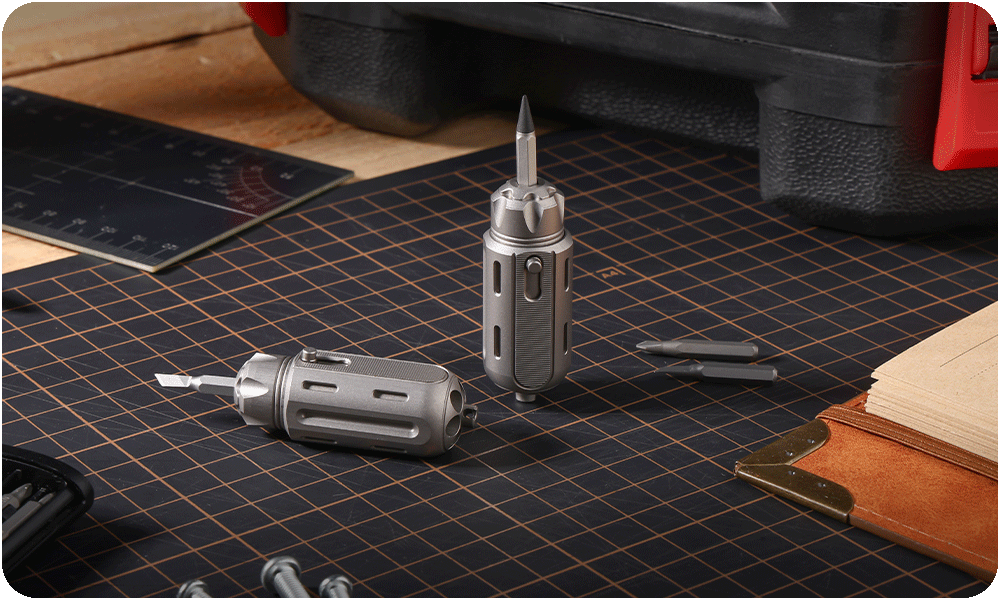
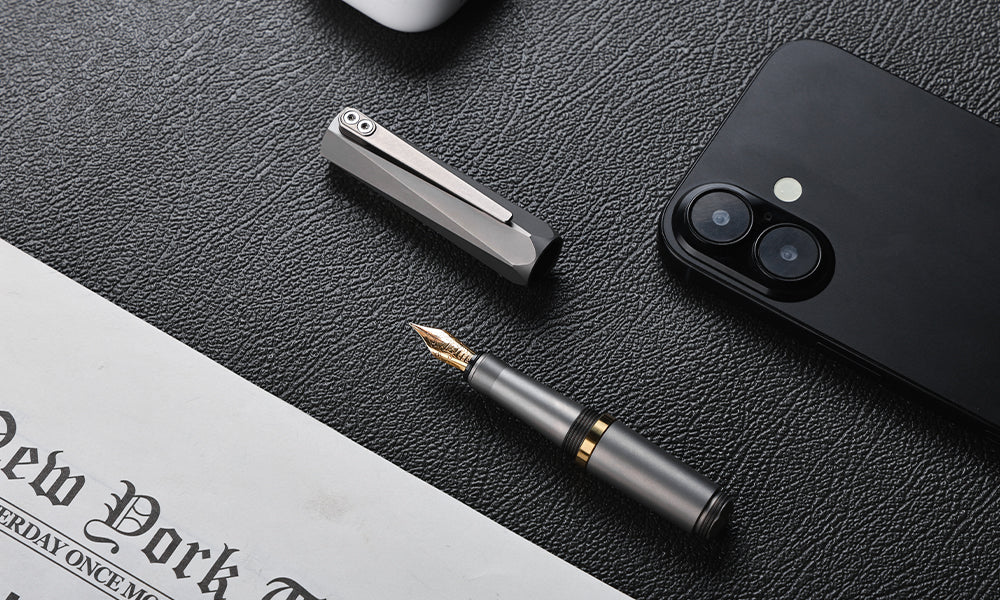
This is Belloc’s home ground: Grade 5 for mechanisms and carry tools; Grade 1 for food-contact titanium. Composite cookware often adds aluminum for heat spread and magnetic stainless for induction — titanium does the surface work, not the entire thermal job.
How Titanium Anodizing Works
Anodizing titanium is an electrochemical process. The part is cleaned (often ending with ultrasonic cleaning), etched in an acid bath so the surface is uniform, then placed in an electrolyte with controlled DC voltage. The part is the anode. Oxide thickness grows with voltage; thickness sets the interference color.
Typical workshop range is about 10–100 volts. Multicolor parts are made by masking or by stepping voltage in sequence, not by mixing pigments.
Approximate voltage-to-color ranges (bath and alloy will shift these):
|
Voltage (DC, approx.) |
Typical color |
|---|---|
|
0 V |
Natural silver-gray (not anodized) |
|
10–20 V |
Pale gold, gold, bronze |
|
20–35 V |
Rose, purple |
|
35–55 V |
Blue, light blue |
|
55–75 V |
Gold, magenta, rose (second band, process-dependent) |
|
75–100 V |
Teal, green |
Treat any chart as a starting recipe. Always lock color on a test coupon from the same alloy and finish. Anodizing also adds a harder oxide, which improves wear slightly; it is not a substitute for a wear coating on a high-abrasion surface.
Colors you should not expect from anodizing alone: red and black.
How to Care for Titanium Products
Titanium is low-maintenance, not zero-maintenance.
-
Wash food-contact Grade 1 pieces with mild detergent. Avoid chlorine bleach soaks.
-
For anodized parts, use a soft cloth. Abrasive powders can scuff the oxide and dull the color.
-
Salt and sweat are not a corrosion threat, but they can leave residue. Rinse after ocean or heavy gym use.
-
Titanium can still scratch. Hairline marks are normal on a soft CP surface and on polished Grade 5.
-
Do not assume every “titanium colored” product is solid titanium. Some items are coated steel or aluminum. Solid Grade 5 is nonmagnetic and feels dense for its size, not hollow-light like stamped aluminum.
Frequently Asked Questions
Is titanium stronger than steel?
Some titanium alloys, especially Grade 5, reach tensile strengths in the same conversation as many steels. The advantage is usually strength at lower weight, not a claim that every titanium part is harder than every steel. Blade edges, for example, still belong to tool steels.
Is titanium hypoallergenic?
Titanium is one of the most skin-tolerant metals in common use. People who react to nickel in jewelry often tolerate titanium well. “Hypoallergenic” is not a medical guarantee for every individual, but titanium is a first-line recommendation for sensitive skin.
Why is titanium so expensive?
Refining titanium (the Kroll process and related routes) is energy-intensive. Melting needs vacuum or inert atmospheres. Machining is slower and consumes more tooling. The metal is abundant in ore; the process is what you pay for.
Can titanium rust?
It does not rust like iron. It can be attacked in a few specific chemical environments (certain hot reducing acids, for example), which is why chemical plants specify Grade 7 or Grade 12. In air, sweat, rain, and seawater, the oxide film is highly protective.
What is the difference between Grade 5 and Grade 23?
Both are Ti-6Al-4V. Grade 23 (ELI) limits oxygen and other interstitials more tightly, which improves toughness for implants. Grade 5 is the standard high-strength alloy for aerospace and most consumer mechanical parts.
Is titanium cookware safe?
Commercially pure Grade 1 titanium is widely used for food contact because it is stable and does not leach like some reactive metals. Belloc uses Grade 1 for cookware and cups. Composite pans may add aluminum and stainless layers for heat and induction; those layers should not be the food surface.
Does anodized color fade?
The color is the oxide thickness, not a dye. It does not peel like paint. Abrasion, polishing, or a new anodize cycle can change or remove it. Daily pocket wear may slowly dull high points.
How can I tell if a product is real titanium?
Ask for the grade (Grade 1, Grade 2, Grade 5 / Ti-6Al-4V). A magnet should not snap to solid titanium. Weight should sit between aluminum (too light) and steel (noticeably heavier). Reputable makers state the grade on the product page.
Talk to Belloc
Questions about grades, finishes, or a specific product? Contact support@bellocedc.com.
Share:
DeckShiv Review: The Magnetic Fidget Slider Utility Knife Built for Everyday Carry
Titanium vs Stainless Steel: Weight, Strength, Rust, and Which to Buy